
First responder walking sea to sea for PTSD
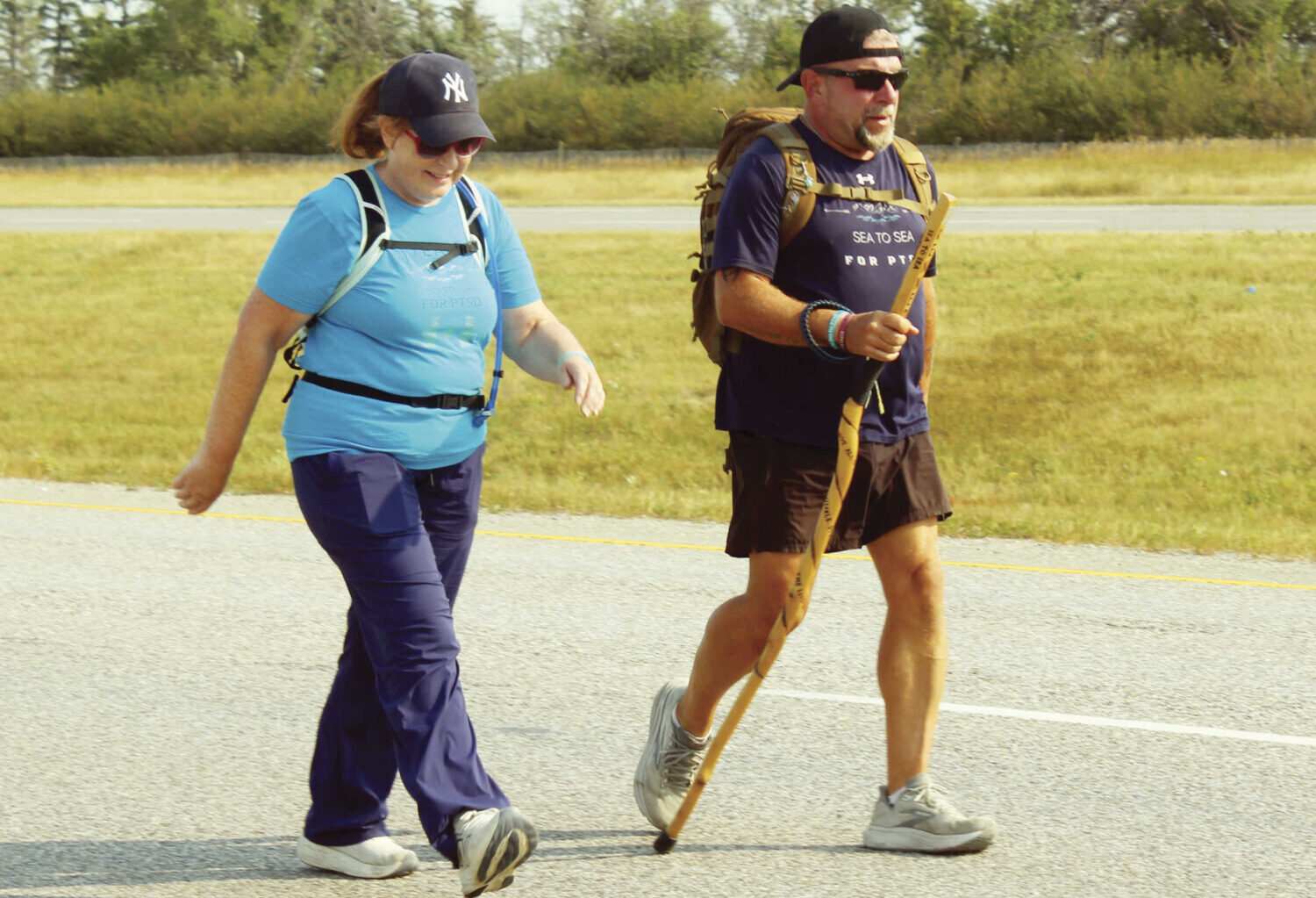
Sea to Sea for PTSD - Chad Kennedy brought his walk from sea to sea for PTSD to Claresholm on Aug. 20, raising awareness of post traumatic stress disorder and the rtesources available to help. From left are Trudi Roth, a fellow first responder, and Kennedy. Photo by Rob Vogt
By Rob Vogt
Chad Kennedy wants to raise awareness about post traumatic stress disorder and emphasize help is available.
For that reason, he has determined to walk sea to sea for PTSD.
He passed through Claresholm recently, escorted by a convoy of emergency vehicles, to continue his walk.
Kennedy also shared his story with local first responders.
He is a Canadian Armed Forces veteran and served 20 years in law enforcement.
His father was also a member of the RCMP.
In 2002, Kennedy’s father was diagnosed with post-traumatic stress disorder.,
“I watched his demise and his rise again,” Kennedy said.
“It’s such a horrible thing to watch.”
In 2004, Kennedy was an auxiliary constable with the RCMP in Fort McMurray, then became a special constable.
After that he patched over to the sheriffs working highway patrol.
In 2017, his father started to see changes in Kennedy’s attitude.
He had become toxic to be around, and saw nothing positive or the good in people.
“I was throwing fits over the smallest things,” Kennedy said.
There was also road rage and anger.
He talked to his doctor, who got him an emergency session at South Campus in Calgary.
Two hours later, Kennedy received the news – “You’ve got PTSD.”
That was the start.
Kennedy was prescribed medication to deal with his fight, flight or freeze reaction.
His doctor also recommended a psychologist in Calgary.
However, that was just not the right fit.
After the third session, Kennedy started calling in sick to the psychologist.
Ironically, he saw other RCMP members going through what his dad did, but could not see it in himself.
So Kennedy kept on working and taking his meds.
Then he was transferred to Banff, where he saw some bad stuff including the aftermath of fatal collisions.
Often, he arrived on scene before emergency medical services.
“That’s the stuff that sticks with me,” Kennedy said. “The sense of uselessness, helplessness.”